
Trace Sharkey County Former Owners Backward
Work a backward chain from the newest deed. The grantor on that deed becomes the buyer on the one before it. The trail repeats deed by deed. Treat every row as a transfer to prove, not a sample of real parties. Keep the legal description beside each entry. Road labels and parcel numbers in Sharkey County can change over time.
| Transfer date | Grantor to grantee | Instrument | Recorded key |
|---|---|---|---|
| Newest date | Seller to current grantee | Latest deed | Book/page or instrument |
| Prior date | Earlier owner to seller | Acquisition deed | Matching legal description |
| Earlier branch | Estate, court, or tax-sale party | Order and deed | Case and land references |
This method keeps an assessor name from standing in for the whole history. Sharkey County former owners form a defensible sequence only when every link reaches a recorded deed or a documented probate branch.
The Chancery Clerk Holds Sharkey County's Deed Chain
The Sharkey County Chancery Clerk records deeds, mortgages, liens, lis pendens, plats, and related land records. The county publishes no general online deed-image or land-index portal. Former-owner work therefore leans on direct and reverse indexes. It also leans on deed books, counter service, and precise mail or email requests.
Send the owner name, parcel or PPIN, exact legal description, date range, and any deed or plat reference. The clerk lists PO Box 218, Rolling Fork, MS 39159-0218, 662-873-2755, and cc@sharkeycountyms.gov. Ask about inspection, image, certification, search, and mailing charges before sending payment.
Note: Call before travel, since post-tornado arrangements may affect which counter holds a requested volume.
Walk a Sharkey County Chain One Grantor at a Time
Anchor the parcel first, then trace it grantor by grantor using the deed references and party roles named in each instrument.
- Start with the newest deed or the assessor's parcel number and legal description.
- Copy the grantee, grantor, deed and recording dates, type, and book/page.
- Search that grantor as an earlier grantee while holding the same land description.
- Repeat for each prior owner and note exceptions, reservations, and exhibits.
- Branch to probate, foreclosure, partition, or tax-sale files when needed.
- Grantor
- The party conveying an interest.
- Grantee
- The party receiving the interest shown by that deed.
- Chain of title
- The linked sequence of transfers affecting the same land.
- Reverse index
- The index used to approach a conveyance from the opposite party role.
- Quitclaim and warranty deed
- Different forms whose effect must be read in the instrument.
How Far Sharkey County Ownership Records Reach
Sharkey County formed in 1876. A recorder directory lists land records reaching back to that era. That founding date sets no online cutoff. The county offers no general web land index, so prior owners must be traced through clerk indexes and deed books once parcel clues run out.
| Source | Years found | Repository | Use |
|---|---|---|---|
| County deed books | Formation forward; exact runs not posted | Chancery Clerk | Transfer chain |
| MDAH land records | 1859, 1876, 1888, 1893, 1909-1910 | State archives | Older holdings |
| Certified abstracts | 1877 and 1880 deeds, certified 1889 | MDAH Series 2050 | Early transfers |
| Historic tax material | Selected years from 1843 onward | MDAH | Bridge gaps |
No online cutoff can be claimed. Ask the clerk about deed books and possible microfilm, then use MDAH finding aids for older records.
MDAH Extends Sharkey County Former-Owner Research
The MDAH finding aid identifies land and tax material older than the modern footprint. A catalog entry is only a locator. It is not proof that every page is scanned. Confirm the series, box, format, and reading-room process before your visit. The MDAH Digital Archives Sharkey series shows the public catalog route.
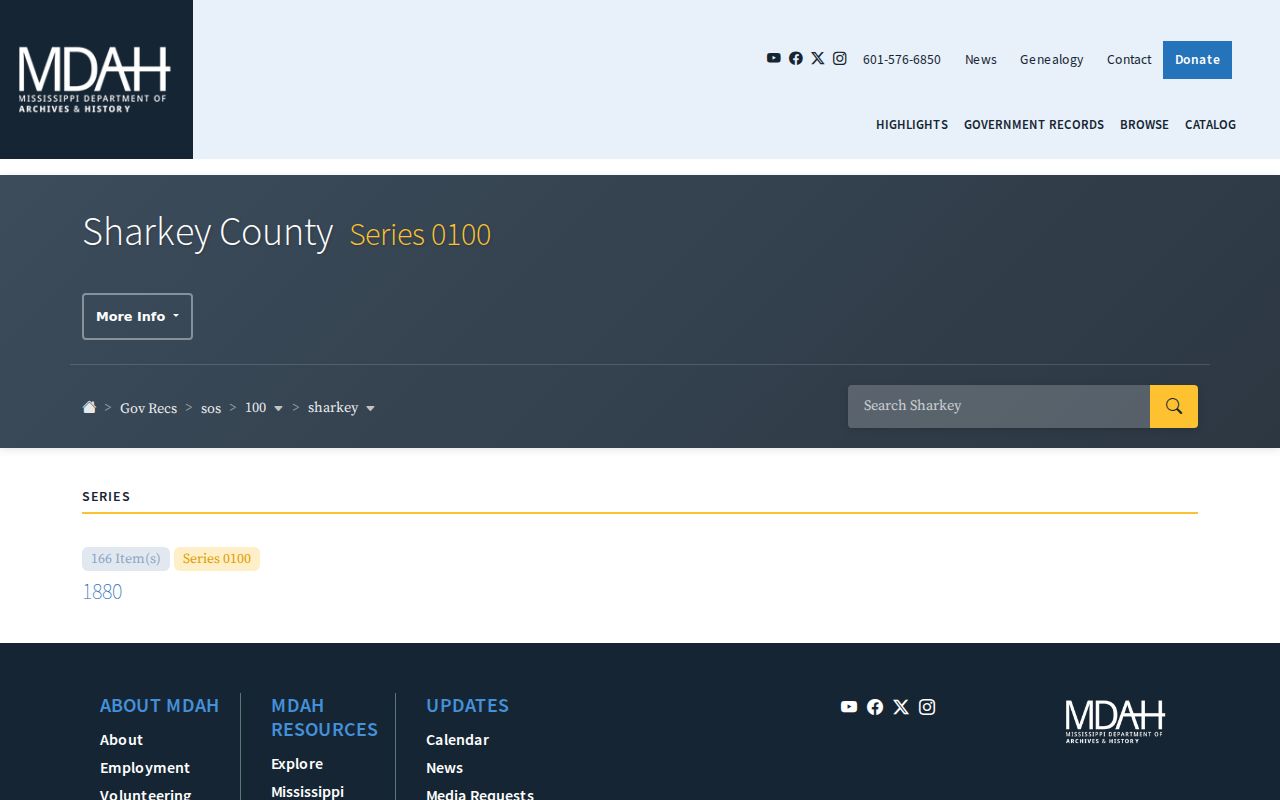
The catalog screen organizes each series for browsing, but every document still must be tied to the same parcel and legal description. Note: County formation does not prove the first land evidence began in 1876; patents and earlier archives may precede it.
An 1880 Sharkey Assessment Correction Can Bridge a Gap
MDAH identifies an 1880 order correcting a real-estate assessment roll. It can matter when a deed sequence skips a name or year. A historic tax roll names the assessed party. The deed supplies the legal conveyance. The two answer different questions.
Assessor holdings listed for 1857, 1859, 1871, and 1881 through 1888 show one thing. A Tax Collector record from 1843 shows another. Together they show why Sharkey County prior owners can surface outside deed books. Those dates are specific archival entries, not proof of uninterrupted coverage.
Probate Is a Sharkey County Ownership Branch
A decedent can stay on the tax roll after death. That alone does not show which heir took title. Sharkey County Chancery probate records may hold a petition, will, inventory, appraisement, heirship findings, and orders. An executor deed may appear there too.
The county's probate instructions identify MEC, in-person, mail, email, and phone access. Search the decedent, representative, case number, and parcel. Then return to the recorder for the order or deed that carried the interest. A trust, life estate, or survivorship arrangement creates a different trail.
Liens and Court Orders Can Interrupt Former Owners
A straight chain can break at foreclosure, partition, quiet title, lis pendens, or tax sale. The court docket explains the authority. The later recorded deed shows the transfer. Search names, legal description, and case number in both places.
Sharkey docket instructions route eligible cases through MEC by party or case number. Some access requires an account. Older files go to the clerk. An advertised sale or order alone never replaces the deed recorded afterward.
Rural Keys Keep Sharkey County Prior Owners Aligned
The state parcel schema includes PARNO, ALTPARNO, PPIN, TAXMAP, SECTION, TWSP, RANGE, LEGLDESC, DEEDREF, and PLATREF. Copy each populated key exactly. Punctuation and zeroes count. A farm owner's mailing city may differ from its situs in Sharkey County, and a legal description can persist after a 911 address changes.
Compare acreage, subdivision, survey grid, and the full description at every transfer. If land was split or combined, request parent and child descriptions plus the recorded plat rather than forcing a current parcel number onto old books.
Limits of Sharkey County Former-Owner Findings
Ownership history can reconstruct recorded transfers and expose an estate or court branch. It cannot turn a GIS owner field, tax roll, abstract, or index line into a title opinion. Unrecorded interests, errors, name variants, and parcel splits need document review.
Use the chain lawfully. Former owners support purchase diligence, estate work, and house history. Never use records to stalk, harass, or target anyone.
The Sharkey County deed records guide walks through the steps for ordering a copy of a single instrument from the recorder. Questions about title, lien priority, or insurability belong with a title professional.